Open-source TeamViewer alternatives in 2026
Open-source alternatives to TeamViewer in 2026
Apache Guacamole gives you browser-based access to the machines you run — and here is exactly where it fits, and where it doesn’t.
- TeamViewer’s paid plans run from about $24.90/month (Remote Access) to $112.90/month (Premium), billed annually, per licensed user, before add-ons.
- Its free tier is for personal use only. TeamViewer watches for commercial use and cuts sessions short when it suspects it.
- Apache Guacamole is open-source (Apache-2.0) and reaches your machines over RDP, VNC, and SSH from a browser tab — nothing to install on the device you connect from.
- DANIAN runs a managed Guacamole instance for €9/month, flat. Patching, daily off-site backups, monitoring, and support are included.
- Honest caveat: Guacamole reaches machines you control on a network you can reach. For ad-hoc support of a PC behind a home router, RustDesk or MeshCentral fit better.
Why teams leave TeamViewer in 2026
TeamViewer still does a lot well. The reasons teams start looking elsewhere in 2026 are narrower: the per-user licensing cost, the annual-only billing, the renewal increases, and the free tier’s commercial-use detection. Each one is a budgeting problem, not a feature gap — which is why an open-source option becomes worth the switch.
The pricing is the first trigger. TeamViewer bills annually, per licensed user — the technician side of the connection. Published list prices run about $24.90/month for Remote Access, $50.90/month for Business, and $112.90/month for Premium, each billed for a full year (TeamViewer pricing). Concurrent sessions, managed-device counts, and add-ons like asset management or device monitoring are priced on top.
The licensing also scales in ways that surprise people. Remote Access covers one user, one live session, and three managed devices. Business lifts the device limit to 200 but is still a single user. Adding simultaneous sessions, so two technicians can work at once, or mobile-device support raises the figure again. The headline price is rarely the final price.
Put it in annual terms and the gap is clearer. Business at about $50.90/month is roughly $611 for the year, for one user. Premium at about $112.90/month is close to $1,355 a year, for a small group of technicians. Add a second concurrent session or device monitoring and the figure climbs from there. For a team that mostly logs into its own servers, that is a recurring line item which doesn’t shrink as the contract renews.
The second trigger is the free tier. It is licensed for personal use only. When TeamViewer’s systems flag a connection as commercial, sessions get cut to a few minutes or blocked, and the only fix is a paid plan. Small IT shops helping clients tend to hit this wall first.
The teams that feel this first are small. A two-person IT shop supporting twenty clients, an agency that logs into client servers, an internal admin covering a single office — none of them are enterprise buyers, and the per-user, per-channel model was not priced for them. When the renewal lands, the search for an open-source option starts.
The third trigger is renewal itself. Reported annual increases of 5–15% are common, and the contract renews unless you cancel in writing well ahead of the term. None of this makes TeamViewer a bad product. It makes the running cost hard to predict — and that is what sends people looking.
What “alternative” actually means here
“Open-source remote access” hides three different shapes, and picking the wrong one wastes a weekend. The real question is not which tool is best. It is whether you are reaching your own machines on a network you can reach, or arbitrary machines sitting behind routers you don’t control. Those need different designs.
A browser-based gateway. One server sits in the middle. Your browser talks to it; it talks RDP, VNC, or SSH out to the target machine. Nothing is installed on the device you connect from, and nothing new runs on most servers you already manage. The catch: the gateway needs a network path to the target. Apache Guacamole is this model.
An agent plus a relay. You install a small client on both ends. A relay server helps the two find each other and punches through home and office routers when a direct path isn’t available. This is the shape TeamViewer itself uses, and it is what you want for spontaneous support of a machine you can’t put on your own network. RustDesk is this model.
An agent-managed fleet. You install an agent on every machine you own, and a web console manages them all — remote desktop, scripts, inventory. It reaches machines behind routers through its own server, and it is built for managing many endpoints rather than reaching a handful of servers. MeshCentral is this model.
The mistake is shopping on features first. All three render a remote screen, transfer files, and sync the clipboard. The difference that matters is reachability: a gateway needs a path to the target, an agent-and-relay tool makes its own path, and a fleet platform manages paths to machines you own at scale. Decide that, and the shortlist picks itself.
The shortlist
Three open-source tools cover almost every remote-access job a small team has. DANIAN runs the first one as a managed service; the other two you would host yourself today. Each is genuinely good — for a different job. Match the tool to the access model above before you read the feature lists.
Apache Guacamole — the one we run
Apache Guacamole is a top-level Apache Software Foundation project under the Apache-2.0 licence, with around 1,600 stars on its main client repository (apache/guacamole-client). It is a browser-based gateway: a web app plus a proxy daemon, guacd, that speaks RDP, VNC, SSH, telnet, and Kubernetes out to your machines. DANIAN runs a managed instance for €9/month.
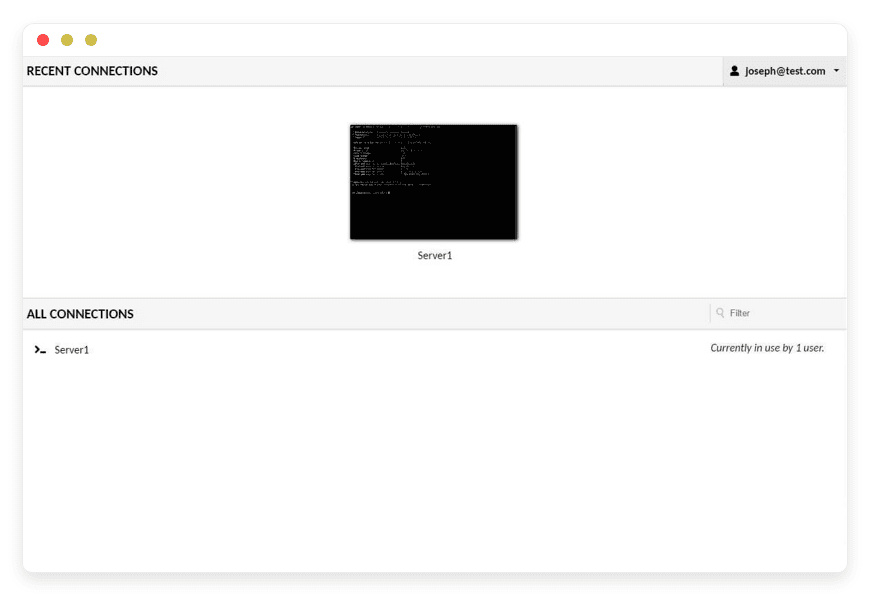
The appeal is what you don’t install. Anyone with a browser and an account can reach a connection — no client on the laptop, no plugin, no app store. Multiple people can share one session, which is useful for support and training. You set access per user and per connection, and you can record sessions for review. Authentication plugs into LDAP, SAML, OpenID Connect, or a database, with time-based one-time passwords for a second factor.
The design is worth understanding, because it explains the limits. Your browser talks to the Guacamole web app over HTTPS. The web app talks to guacd, which speaks the real protocols — RDP, VNC, SSH — out to your machines (Guacamole manual). The browser never speaks RDP itself, which is why nothing installs on your side. But guacd has to reach the target, which is why the gateway needs a route to it.
Best for: your own servers, workstations, and lab — anything you can reach over a LAN, a VPN, or a tunnel. It is the strongest fit for an IT team that wants one front door to its own infrastructure.
RustDesk — the closest match to the TeamViewer flow
RustDesk is an open-source remote desktop built as a TeamViewer replacement, with well over 110,000 GitHub stars and an AGPL-v3 licence (rustdesk/rustdesk). You install a client on both machines; a relay and signalling server, which you can host yourself, connects them through home and office routers. It works where you can’t pre-arrange a network path.
This is the tool for the job Guacamole won’t do: reaching a machine you don’t control the network for. The trade is that you install software on both ends, so it doesn’t suit kiosks or locked-down customer machines where you can’t add a client. The open-source server is a relay only — its web console and API live in the paid Server Pro tier. It is not in DANIAN’s catalogue today; you would run the relay yourself.
MeshCentral — for managing a fleet you own
MeshCentral is an open-source, web-based platform under the Apache-2.0 licence for managing many machines at once — remote desktop, file transfer, scripts, and inventory in one console. An agent runs on each endpoint and reports to your server, which reaches devices through routers without per-machine setup. It is heavier than a plain gateway, and built for scale.
Reach for MeshCentral when you own a fleet — dozens of laptops or servers you want under one roof, with monitoring and remote control together. The desktop runs in the browser and is fine for administration, less so for high-frame-rate work. Like RustDesk, it is agent-based and self-hosted, and it is not on DANIAN’s catalogue today. If your need is one clean front door to servers rather than fleet management, Guacamole is the simpler pick.
Guacamole vs TeamViewer at a glance
The two tools solve overlapping problems with different economics. TeamViewer is a per-user subscription that reaches almost any machine out of the box. A managed Guacamole instance is a flat monthly price that reaches machines you can put on a network you reach. The table below sets the trade-offs side by side.
| Feature | TeamViewer | Apache Guacamole (managed by DANIAN) |
|---|---|---|
| Access model | Agent plus relay; reaches machines behind any router | Browser-based gateway; reaches machines you can connect to over the network |
| Install on the device you connect from | TeamViewer client | Nothing — any modern browser |
| Protocols | TeamViewer’s own protocol | RDP, VNC, SSH, telnet, Kubernetes |
| Pricing model | Per licensed user, billed annually | Flat €9/month per instance |
| Illustrative cost | ~$50.90/month (Business) to ~$112.90/month (Premium), billed annually, before add-ons | €9/month, all-inclusive |
| Source code | Closed | Open (Apache-2.0) |
| Who hosts it | TeamViewer | DANIAN, in the region you choose |
| Shared sessions | Yes | Yes (connection sharing) |
| Best fit | Ad-hoc support of machines on networks you don’t control | One front door to your own servers, workstations, and lab |
Read the table as a trade, not a verdict. TeamViewer’s strength is that it reaches almost anything with no network setup, which is exactly what ad-hoc support needs. Guacamole’s strength is a flat price and clientless access to infrastructure you already run. A small team accessing its own servers pays €9 once; the same team on TeamViewer pays per technician, every year, before add-ons.
The three open-source options line up like this:
| Tool | Access model | Licence | Reaches machines behind routers | Endpoint agent | Hosted by DANIAN | Best for |
|---|---|---|---|---|---|---|
| Apache Guacamole | Browser-based gateway | Apache-2.0 | Only with a network path (VPN or tunnel) | None | Yes — €9/month | Your own servers, workstations, lab |
| RustDesk | Agent plus relay | AGPL-v3 | Yes (relay and NAT traversal) | Yes, both ends | No (self-host) | TeamViewer-style ad-hoc support |
| MeshCentral | Agent-managed fleet | Apache-2.0 | Yes (via its own server) | Yes, each endpoint | No (self-host) | Managing a fleet you own |
How DANIAN runs Guacamole
DANIAN runs a managed Guacamole instance for €9/month, in the region you choose across 21 datacenter locations. We patch the gateway, back it up daily off-site, monitor it, and answer chat when you need us. You add your machines as connections, set who can reach what, and turn on session recording if you want it. You don’t touch a server.
What’s included is the operations, not just the software. The €9 covers the instance, security patches, daily backups, monitoring, and 24/7 support from a named person. We won’t upgrade your resources or charge you more without your say-so. If a session ever needs more headroom, we ask first.
Security defaults are set sensibly from the start. The instance is served over HTTPS, you can require a time-based one-time code as a second factor, and access is granted per user and per connection so people reach only the machines they should. If you want a record of who connected to what, session recording is a switch, and the history stays on your instance. None of it needs a server you manage.
A typical setup is one gateway in front of a mixed environment. A small team points it at a few Windows servers over RDP and a couple of Linux boxes over SSH, all from one tab. An agency reaching client servers runs the gateway over a VPN or tunnel to each client’s network, with per-user access so staff only see the clients they handle. One instance, many machines.
Getting started looks the same either way. You point the gateway at one machine — a single Windows server over RDP is the usual first test — confirm you can reach it from a browser, then add the rest. Most teams have their core machines connected within an afternoon, and there is no client to roll out to the people who will use it.
What’s honest about the limits: the gateway still needs a network path to your machines. That usually means a LAN, a VPN, or a tunnel, and we help set it up. For a PC on a home network with no inbound path, this model isn’t the fit — that is where an agent-and-relay tool earns its place. See managed Apache Guacamole hosting for the setup detail.
Self-host it, or have it run for you
You can run Guacamole yourself, and for some teams that is the right call. The honest comparison is not software-versus-software — both are the same open-source app. It is whether you want to own the server work, or pay a flat price to skip it. Here is what each path costs.
The do-it-yourself path starts cheap and adds up. A production-class VPS at 2 vCPU and 4 GB runs about $24/month, plus roughly $5 for off-site backups and $15 for proper monitoring — call it $44/month in infrastructure. Then there is the build: Tomcat, guacd, the protocol libraries, a reverse proxy, TLS certificates, and an authentication extension. After that, the monthly patching, certificate renewal, and backup checks. At freelance sysadmin rates of €60–120/hour, that time is €60–240/month. If you have someone in-house who enjoys this work, it is a good path.
The build is where most weekends go. guacd compiles against the protocol libraries — FreeRDP for RDP, libssh2 for SSH, libVNCserver for VNC — and a mismatch there is a common first wall. After that, the reverse proxy and TLS need to be right, and recent releases exist partly to fix resource leaks and protocol bugs you would otherwise carry. None of it is exotic. It is steady, ongoing work that has to happen on schedule.
DANIAN’s managed path is the other end: €9/month, and the server work is ours. No build weekend, no patch cycle, no on-call.
DANIAN’s pricing is one flat figure per app, so the bill doesn’t move with usage. The choice is time versus money, and it is an honest one.
How to pick — three questions
You can skip most of the comparison noise by answering three questions in order. Each one points to a different tool, and they rarely all point the same way. Answer them about your real machines and your real network, not the demo.
- Are you reaching your own machines, or machines on networks you don’t control? Your own points to a gateway like Guacamole. Other people’s points to an agent-and-relay tool like RustDesk.
- Can you install software on the target, or do you need clientless access? If you can install, RustDesk or MeshCentral work. If you can’t, Guacamole adds nothing to the endpoint.
- Do you want to run the server, or pay to have it run? Run it yourself by self-hosting any of the three. Skip the work with a managed Guacamole instance at €9/month.
FAQ
Is Apache Guacamole really free?
Yes. Guacamole is open-source under the Apache-2.0 licence, so the software costs nothing and the code is yours to inspect. What you pay for is hosting and operations — the server it runs on, the patching, the backups, and support. DANIAN bundles all of that into €9/month per instance.
What is the best open-source alternative to TeamViewer?
It depends on what you are reaching. For your own servers and workstations, Apache Guacamole gives clientless browser access over RDP, VNC, and SSH. For ad-hoc support of a machine behind a router you don’t control, RustDesk fits better. For managing a fleet you own, MeshCentral. Match the tool to the access model, not the feature list.
Is Apache Guacamole a good replacement for TeamViewer?
For reaching your own servers, workstations, and lab, yes — Guacamole gives the same remote screen, file transfer, and shared sessions from a browser, at a flat price. For spontaneous support of a machine on a network you don’t control, it is not a like-for-like swap; an agent-and-relay tool like RustDesk is the closer match.
Can Guacamole reach a PC behind a home router, like TeamViewer?
Not on its own. Guacamole needs a network path to the target — a LAN, a VPN, or a tunnel. For a machine behind a router you don’t control, with no inbound path, an agent-and-relay tool like RustDesk or a fleet platform like MeshCentral is the better fit. Match the model to the machine.
Do I install anything on the computer I connect from?
No. You open a browser, sign in, and the connection appears in a tab. There is no client, plugin, or app to install on your laptop. The machine you are reaching does need a standard RDP, VNC, or SSH service running, which most servers and workstations already have.
Do I need a VPN to use Guacamole?
Only if your machines aren’t already reachable from the gateway. Guacamole needs a network path to each target — a LAN, a VPN, or a tunnel. Machines on the same private network as the gateway need nothing extra. For servers on separate networks, a VPN or tunnel gives the gateway its route, and we help set that up.
What protocols does Guacamole support?
RDP for Windows, VNC for Linux and macOS desktops, and SSH or telnet for command-line access — plus Kubernetes. They all open in the same browser tab through one gateway, so a mixed environment of Windows servers and Linux boxes lives behind a single front door.
Can I access my machines from a phone or tablet?
Yes. Because Guacamole runs in the browser, any device with a modern browser works — a laptop, a phone, or a tablet — with nothing to install. It suits quick checks and command-line work well; for detailed graphical work, a larger screen is easier. Your sign-in and permissions are the same on every device.
Can more than one person join the same session?
Yes. Guacamole supports connection sharing, so several people can view or control one session at once. It is useful for live support, pair work, and training, where one person drives and others watch. Each user’s access is set per connection, so sharing is deliberate, not accidental.
Can I transfer files through Guacamole?
Yes. Guacamole supports file transfer over RDP and SSH connections, so you can move files to and from the machine you are reaching without a separate tool. Transfers run through the same browser session, and access follows the per-connection permissions you set, so file access stays deliberate rather than automatic.
Can I record remote sessions for review?
Yes. Guacamole can record sessions, and on a DANIAN instance you turn it on per connection. The recordings and the connection history stay on your own instance, so you keep a record of who reached which machine and when. It is useful for training, handovers, and checking work after the fact.
Is Apache Guacamole secure?
It can be, and the defaults on a DANIAN instance are set for it. The connection runs over HTTPS, access is granted per user and per connection, and you can require a second factor at sign-in. We also patch the gateway on a schedule, since out-of-date software is the more common risk than the design itself.
Does Guacamole support two-factor authentication?
Yes. Guacamole supports time-based one-time passwords — the six-digit codes from an authenticator app — as a second factor at sign-in. It also connects to single sign-on through LDAP, SAML, or OpenID Connect if you run one. On a DANIAN instance, we help you switch the second factor on.
How long does it take to set up managed Guacamole?
The instance itself is ready quickly — you sign in the same day. The time that follows is adding your machines as connections and confirming the gateway can reach each one. Most teams have their core servers connected within an afternoon, and there is no client to roll out to the people who will use it.
Do I need technical skills to use managed Guacamole?
To use it day to day, no — you sign in and open a connection in a browser. To set it up, you add connections and decide who can reach what, which is straightforward admin work. The server side — patching, backups, the build — is ours, so the deeper infrastructure work isn’t on you.
How do I migrate from TeamViewer to Guacamole?
There is no data to move — you are switching how you reach machines, not transferring files. You stand up the gateway, add each machine as an RDP, VNC, or SSH connection, set who can reach what, then retire the TeamViewer clients once the new access is confirmed. Running both for a short overlap keeps the switch low-risk.
What access do I get to my instance?
You get the Guacamole admin interface to add connections and set permissions, plus per-container terminal and file access through the DANIAN dashboard. We handle patching, backups, and monitoring; you handle your connections and users. When something needs a human, chat reaches a named person, not a queue.
Who keeps Guacamole patched and updated if DANIAN hosts it?
We do. Security patches, version upgrades, and the underlying server maintenance are part of the €9/month — you don’t track releases or schedule downtime. Recent Guacamole versions exist partly to fix protocol bugs and resource leaks, and applying them on time is the kind of steady work the managed price covers.
What happens if my Guacamole instance goes down?
We monitor it and work to bring it back; that is part of what the €9/month covers. Your configuration and connections are backed up daily off-site, so a recovery restores your setup rather than starting over. When something needs a human, chat reaches a named person rather than a ticket queue.
How does the cost compare to TeamViewer?
DANIAN runs a managed Guacamole instance at a flat €9/month, all-inclusive. TeamViewer’s paid plans run from about $24.90/month to $112.90/month, billed annually, per licensed user, before add-ons. One instance can reach many machines, so the gap usually widens as the number of devices grows.
Are there any per-user or per-seat fees?
No. A DANIAN Guacamole instance is a flat €9/month, whatever the number of people who sign in or machines you connect. That is the main cost difference from a per-licensed-user model: adding a second technician or a tenth server doesn’t change the bill. The price moves only if you add a separate app.
How many machines can one Guacamole instance reach?
One instance can front many machines — you add each as a connection and the gateway reaches all of them from one place. The practical limit is how much simultaneous traffic the instance handles, not a licensed device count. For a small team’s mix of servers and workstations, a single instance is usually enough.
What if I want to leave?
Your configuration and data export on demand, and the software is open-source, so nothing is locked to us. You can take a Guacamole setup and run it anywhere. We would rather earn the renewal than trap you — the €9 buys a service, not a cage.
What to do this week
Start by naming the access model, not the tool. If you mostly reach your own servers, workstations, and lab, a managed Guacamole instance gives you one browser-based front door without a server to run. Point it at a single machine first, and add the rest once it feels right.
If your real need is helping someone with a machine on a network you don’t control, look at RustDesk or MeshCentral before anything else — that is the job they are built for. And if you like running infrastructure, self-hosting any of the three is a fair path; the cost is your time, not a per-seat licence.
For the gateway route with none of the server work, start a 7-day trial of managed Guacamole at €9/month. No card, and you can point it at a real machine the same day.