Open-source Bitly alternatives in 2026
Open-source alternatives to Bitly in 2026 — Kutt and Yourls when the free tier drops to 5 links
TL;DR
- Bitly's free plan now caps you at 5 new links a month, with no custom domain and no link-level click data.
- The first Bitly tier with a branded short domain and exportable analytics is Growth, at $35/month on monthly billing ($348/year annual) — and it still caps you at 500 links a month.
- Kutt (about 10,600 GitHub stars) and Yourls (about 12,000 stars) are MIT-licensed, self-hostable shorteners. Both give you a branded domain, no monthly link cap, and click data that lives in your own database.
- Kutt is the modern pick: a clean dashboard, a REST API, password-protected and expiring links. Yourls is the veteran: proven PHP, a large plugin ecosystem, a scriptable API.
- We run either one for €9/month, flat — the custom domain and SSL wired up, daily off-site backups, and the click data stays yours.
Why people are leaving Bitly in 2026
Bitly's free plan is now a trial, not a tool.
You get 5 new links a month, 2 QR codes, no custom domain, and no link-level click analytics — only landing-page views.
Anyone sharing more than a handful of links a month hits the cap within days, and that cap is what starts most searches for an alternative.
The paid ladder climbs steeply, and it climbs on the wrong axis. You do not pay for clicks — those are unlimited on every tier. You pay for how many links you create each month and for how long Bitly keeps your data.
- Free — $0. 5 links/month, 2 QR codes, no custom domain, no historical click data.
- Core — $10/month, billed annually only ($120/year). 100 links/month, 30 days of click data, and still no custom domain.
- Growth — $35/month, or $29/month on annual billing ($348/year). 500 links/month, a complimentary custom domain, 4 months of data, and data export.
- Premium — $300/month, or $199/month annually ($2,388/year). 3,000 links/month, one year of data, city-level analytics.
Two things in that table do the work. The custom domain — the thing that turns bit.ly/3xYz into go.yourbrand.com/launch — is locked behind the $35/month Growth plan. So is data export: on Free and Core, you cannot take your own click history out of Bitly. You are renting both your branding and your data.
The link cap bites faster than people expect. A small marketing team running three campaigns at once, an agency managing links for several clients, or an affiliate building out product links can pass 100 links in a month without trying. That pushes them from Core to Growth, from $10 to $35, and the next ceiling at 500 links is closer than it looks.
The data-retention limit is the quieter problem. On Core, your click history disappears after 30 days. On Growth, after four months. So the reporting you are paying for is also the reporting you lose — right when you want to compare this quarter's campaign to last year's. To keep a full year of history you are on Premium at $199–$300 a month.
None of this makes Bitly a bad product. Its analytics go deep at the top tiers, its QR-code studio is mature, and its mobile apps and integrations are broad. The question is narrower: if all you need is branded short links, click stats, and control of your own data, are you getting that for $35–$300 a month, or paying for a platform you mostly do not use? Bitly's pricing page has the current tiers in full.
What “alternative” actually means here
“Alternative to Bitly” is really three different decisions, and they do not solve the same problem. One swaps your bill, one hands you full ownership at the cost of running a server, and one gives you the ownership without the server. Picking the right one is what stops you paying for the wrong thing twice.
Switch to a cheaper proprietary shortener. There are plenty of them, and several undercut Bitly on price. This usually trades one subscription for a smaller one and one lock-in for another. Your links and click data still live in someone else's account, on someone else's terms, behind someone else's next pricing change. It solves the bill, not the ownership — and ownership is usually the reason people leave Bitly in the first place.
Self-host an open-source shortener yourself. This is the real fix for ownership. You run the software on your own server, point your domain at it, and the data never leaves your database. The cost is operational: Kutt needs Node.js; Yourls needs PHP, a MySQL or MariaDB database, and a web server with URL rewriting. On top of that sit the custom-domain and SSL wiring, the patching, and the backups.
Budget roughly $24/month for a production-class VPS plus a few hours a month of your time. If you have a developer in-house who is happy owning that — on a plain VPS, or via a self-hosted platform like Coolify — this is a genuinely good path.
Have someone run the open-source app for you. This is managed open-source. You get the data ownership of self-hosting without owning the server, the patch cycle, or the 2am pager. The app and its database are still yours; you simply do not operate the box. That is what we do at DANIAN, for €9/month per app.
The rest of this guide assumes you have decided ownership matters — otherwise you would stay on a SaaS — and walks through the two open-source shorteners worth running, the trade-offs between them, and what switching actually involves.
The shortlist
Kutt — the modern self-hosted shortener
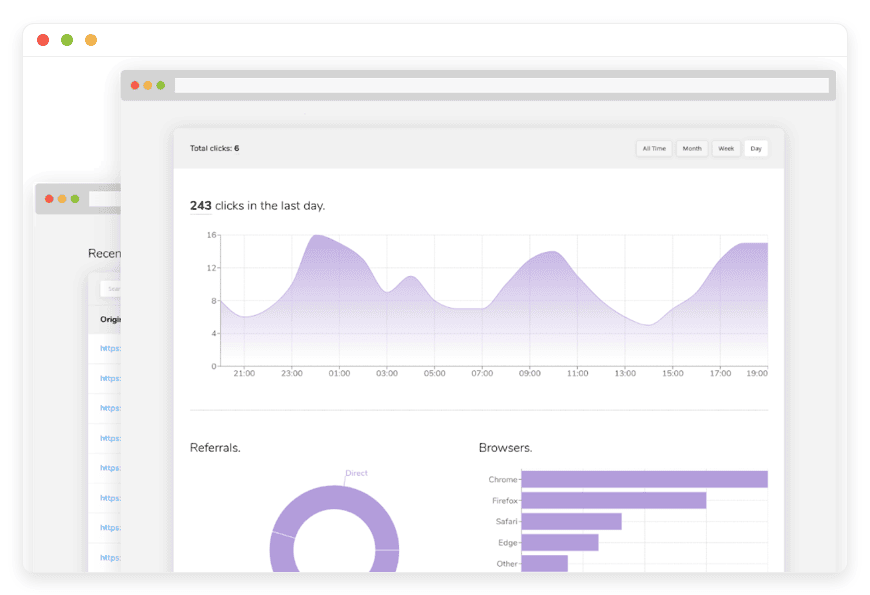
Kutt is a modern URL shortener built by the thedevs-network community, MIT-licensed, with around 10,600 GitHub stars. The current version runs on Node.js, with SQLite by default and Postgres or MySQL/MariaDB as options. It shortens links, manages them, and shows per-link click statistics from a clean dashboard.
Best for: teams that want a tidy interface and an API.
What you get: support for multiple custom domains, custom link aliases, password-protected links, link descriptions, and expiry dates. Statistics are private to your account. There is a full REST API, an admin role that can view and ban links, and a private mode that disables public registration so only your team can create links. You can wire it into tools like ShareX as your default shortener.
Where Kutt earns its place is everyday branded links with controls attached. Marketing teams use it to publish trackable links on their own domain, such as go.yourcompany.com/launch, instead of a public shortener everyone recognises. Product and developer teams use the API to generate links automatically for release notes, beta signups, and docs, with expiry dates that retire a link on schedule. Password protection and private mode make it a fit for internal links a team would rather not expose.
The honest limits: Kutt's analytics are useful but lighter than Bitly's campaign-level reporting, and it has no built-in QR-code studio. If you need deep marketing attribution dashboards, Kutt is leaner. If you need branded links, an API, and modern link controls, it covers them well. We offer managed Kutt hosting if you would rather not run the Node.js stack yourself. Kutt's source and docs live on its GitHub repository, and the project's hosted instance is at kutt.to.
Yourls — the battle-tested workhorse
Yourls — short for “Your Own URL Shortener” — has been the default self-hosted shortener since 2009. It is maintained by Ozh Richard and a community of more than 100 contributors, MIT-licensed, with around 12,000 GitHub stars. It is a small set of PHP scripts you run on your own server, in the spirit of TinyURL or Bitly, but with your data under your control.
Best for: people who want maximum extensibility and a proven core.
What you get: custom keywords for every link, detailed statistics covering clicks, referrers, geography, and activity over time, a developer API, and bookmarklets for one-click shortening. The real strength is the plugin ecosystem — the community-curated Awesome Yourls list covers spam filtering, bot-hit exclusion, QR codes, rate limiting, and dozens of other extensions. Running it needs PHP 8.1 or above, a MySQL or MariaDB database, and Apache or Nginx with URL rewriting enabled.
Yourls suits people who treat a shortener as infrastructure rather than a dashboard. The API is scriptable, so it slots into existing tooling; the plugin model means you can add exactly the behaviour you need and nothing you do not. Long-running projects value that the core has barely broken backward compatibility in fifteen years — links made in 2012 still resolve. For a publisher, a community, or a team that wants one short domain it fully controls, that stability is the selling point.
The honest limit: the default admin interface is dated and basic. Reviewers who love Yourls say the same thing — its value is the stable core and the plugins, not the visual polish. If you want a modern dashboard out of the box, Kutt fits better; if you want a shortener you can bend to almost any workflow, Yourls is hard to beat. We offer managed Yourls hosting for teams that want the plugin ecosystem without the server admin. The project lives at yourls.org and on GitHub.
Kutt vs Yourls vs Bitly — at a glance
| Feature | Kutt | Yourls | Bitly (for reference) |
|---|---|---|---|
| What it is | Modern open-source shortener (Node.js) | Veteran open-source shortener (PHP) | Proprietary SaaS |
| License | MIT, open source | MIT, open source | Closed |
| GitHub stars | ~10,600 | ~12,000 | — |
| Links per month | No cap (your server) | No cap (your server) | 5 free / 100 Core / 500 Growth / 3,000 Premium |
| Custom branded domain | Yes, included | Yes, included | From Growth ($35/month) |
| Click analytics | Private per-link stats | Detailed stats + plugins | Yes; deeper at higher tiers |
| Who holds your click data | You (your database) | You (your database) | Bitly |
| Data export | Yours — it is your database | Yours — it is your database | From Growth ($35/month) up |
| API | REST API | Developer API | Volume-capped by tier |
| Run it yourself | Node.js 20+ | PHP 8.1+ and MySQL | Not applicable (hosted) |
| Managed by DANIAN | €9/month | €9/month | — |
The cost line, stated plainly: Bitly's Growth tier — the cheapest plan that includes a branded domain — is $35/month, or $348/year on annual billing, capped at 500 links. A managed Kutt or Yourls instance is €9/month, €108/year, with the domain and SSL included and no link ceiling. You are comparing a metered platform against a flat per-app price, and the gap widens the more links you create.
Switching from Bitly: what carries over and what doesn't
The honest part of any migration is what you cannot bring with you. Your existing bit.ly short links live on Bitly's domain, so they cannot move to a shortener on your own domain — the domain is the link. The fix is to switch the source of new links, not to port the old ones byte-for-byte.
In practice that means three steps. First, stand up your own branded domain on Kutt or Yourls and start creating new links there. Second, recreate the handful of links you still hand out often, or bulk-import them through the app's API or a CSV so the new short codes exist on your domain. Third, decide what to do with the old bit.ly links already printed on materials or sitting in old posts: they keep resolving as long as your Bitly account stays open, so many people keep a free or low tier alive purely to let legacy links work, then let it lapse once traffic dries up.
Your historical click data is worth grabbing before you go. If you are on Growth or Premium, export your click history while the account is active — on Free and Core, export is not available, so the data stays behind. From the switch onward, every new link and every click sits in your own instance's database, which is the entire point of moving.
One more thing worth checking is QR codes. If you lean on Bitly's QR-code studio, know that Kutt does not generate codes itself and Yourls handles them through a plugin rather than a polished built-in tool. For most teams a short link and a separate QR generator cover it, but if dynamic, editable QR campaigns are central to your work, that is one area where Bitly's bundled feature is genuinely ahead, and worth weighing before you switch.
How to pick: three questions to ask yourself
The choice between the two apps is genuine, and so is the choice between self-hosting and managed. Three questions settle most of it: what you want the tool to feel like, who will keep it running, and how much owning your own data actually matters to you. Work through them in order.
- Do you want a modern dashboard and an API, or maximum extensibility? Kutt gives you a clean interface and link controls out of the box. Yourls gives you a proven core and a plugin for almost anything. Pick Kutt for polish, Yourls for reach.
- How technical is the person who will run it day to day? Self-hosting either app means owning a server, a database, the patch cycle, and SSL renewals. If you have a developer who enjoys that work, self-host and keep the $24/month VPS bill. If you do not, the honest answer is managed hosting — the maintenance does not go away, it just moves to someone else.
- How much does owning your click data matter? If the whole point is that your link data sits on infrastructure you control, both apps deliver it equally. The only open question left is who runs the box — you, or someone you pay to do it.
How DANIAN runs Kutt and Yourls
For €9/month per app, we run a dedicated instance of Kutt or Yourls for you. We deploy it in the region you choose — we operate across 21 datacenter locations on six continents — and we wire up your custom domain with its SSL certificate. We patch the app, monitor it, and back it up daily, off-site.
The custom-domain and SSL step is the part that trips most people up when they self-host a shortener: the DNS records, the certificate, the redirect rules that make a bare domain resolve. That is the piece we handle, so your branded links work on day one rather than after an afternoon of debugging. Your click data sits in your instance's own database, and you reach the app through a dashboard and per-container file and terminal access when you need to dig in.
What is included is the whole operational layer: the server, security patches, daily off-site backups, monitoring, and support over chat and email with a named person. What is not included is anything that pretends the software is something it is not — Kutt's analytics are Kutt's analytics, and we do not bolt on features the project does not have. We will not upgrade your resources or charge you more without asking first, and if a card fails, we wait rather than delete your data. The app is yours; we operate it, and you can take it with you if you leave.
Start a 7-day trial and point a test domain at an instance before you commit.
Pricing
€9/month per app.
No per-seat fees, no per-link metering, no separate charge for a branded domain.
The price covers the server, security patches, daily backups, monitoring, and support.
There is a 7-day free trial, and no credit card is needed to start.
FAQ
What is the best open-source alternative to Bitly?
There is no single best one; it depends on what you need. Kutt suits teams that want a modern dashboard, an API, and link controls. Yourls suits people who want a proven core and a large plugin library. Both are MIT-licensed, and both give you a branded domain and click data you own.
Is Kutt really free?
Yes. Kutt is MIT-licensed open-source software, so the program itself costs nothing to use or modify. What you pay for is somewhere to run it: your own server, or €9/month for us to run a managed instance for you. The same is true of Yourls. “Free software” and “free to operate” are two different things.
What's the difference between Kutt and Yourls?
Kutt is a modern Node.js app with a clean dashboard, a REST API, and built-in link passwords and expiry. Yourls is a veteran PHP app with a large plugin ecosystem and a proven, scriptable core. Choose Kutt for a polished interface and an API; choose Yourls for extensibility and the plugin library.
Is Kutt or Yourls better for a non-technical marketing team?
For most marketing teams, Kutt is the easier starting point. Its dashboard is modern, and branded links, click stats, expiry dates, and private mode work without configuration. Yourls is more capable once extended, but its default admin screen is dated. Either way, managed hosting removes the server setup a non-technical team would rather skip.
How many links can I create with a self-hosted shortener?
There is no monthly link cap. Kutt and Yourls store links in your own database, so the only limit is your server's disk and capacity. That is the core contrast with Bitly, which meters new links by plan: 5 on Free, 100 on Core, 500 on Growth, and 3,000 on Premium.
Do Kutt and Yourls give me click analytics like Bitly?
Yes, both track clicks. Kutt shows private per-link statistics from its dashboard. Yourls records clicks, referrers, geography, and activity over time, and extends further through plugins. The reporting is lighter than Bitly's campaign-level analytics at its higher tiers, but the data sits in your own database, not a vendor's account.
Can I use my own short domain?
Yes, with either app, and it is included — not gated behind a paid tier the way a branded domain is on Bitly's Growth plan. If we run the instance for you, we set up the domain and its SSL certificate so your links work on your own brand from the first day, with no certificate juggling on your side.
Can Kutt or Yourls generate QR codes?
Not as a polished built-in feature. Kutt does not generate QR codes itself. Yourls can, through a plugin rather than a bundled studio. For most teams a short link plus a separate QR tool is enough. If editable, dynamic QR campaigns are central to your work, Bitly's bundled QR studio is still ahead.
Do Kutt and Yourls have an API?
Yes. Kutt has a REST API for creating and managing links programmatically. Yourls has its own developer API and supports bookmarklets for one-click shortening. Both let you generate links from scripts, release pipelines, or other tools, so a shortener can run as infrastructure rather than something you click through by hand.
Do I need to know how to code to use Kutt or Yourls?
No. Day to day, you create and manage links from a web dashboard, with no code involved. The technical part is the setup: installing the app, the database, SSL, and the redirect rules. That is the work a developer handles when self-hosting, or that managed hosting handles for you for €9/month.
Do Kutt and Yourls require Docker?
No. Docker is one option, not a requirement. Kutt needs only Node.js 20 or above, with SQLite by default. Yourls is a set of PHP scripts you run on a standard web server with a MySQL or MariaDB database. Both also publish official Docker images if you prefer that route.
What's the difference between Kutt's hosted version and running your own instance?
Kutt's project runs a shared hosted instance at kutt.to, which is handy for quick links but shared with other users. Running your own instance, self-hosted or managed, gives you a private deployment, your own branded domain, your own database, and no shared-tenant limits on what you can create.
Can I migrate my existing Bitly links to Kutt or Yourls?
You can move forward, but not port the old links as they are. Existing bit.ly links live on Bitly's domain, so they cannot resolve from your domain. The practical path is to create new links on Kutt or Yourls, bulk-import the ones you reuse, and keep the Bitly account open while legacy links still get traffic.
How does this compare to running it on my own VPS?
Self-hosting runs about $24/month for a production-class VPS, plus a few hours a month for patching, backups, and SSL upkeep. If you have a developer who enjoys that, it is a fine and cheaper path. If you do not, €9/month removes the server, the patch cycle, and the maintenance entirely, and you still own the data.
What's the cheapest way to get branded short links?
Two paths are far cheaper than Bitly's branded-domain tier. Self-host Kutt or Yourls on a production-class VPS at roughly $24/month if you will maintain it. Or use managed hosting at €9/month with the domain and SSL set up for you. Bitly's cheapest plan with a branded domain is Growth, at $35/month.
Who can see my click data?
You do. On a self-hosted shortener, click statistics live in your own database, not a vendor's account. You decide who has access, you can export the data whenever you want, and you can delete it. Nobody is holding your link history to upsell you a higher tier later.
Where is my data stored if DANIAN hosts my shortener?
In your own instance's database, in the datacenter region you choose. We operate across 21 datacenter locations on six continents, so you can place the instance close to your users. Your links and click history stay in that database; you can export them whenever you want, and you decide who has access.
Is a self-hosted URL shortener secure?
It can be, and the main factors are in your control. Security comes down to keeping the app and server patched, using strong admin credentials, and locking down database access. Self-hosting puts that work on you. Managed hosting covers the patching, SSL, and backups, so the routine maintenance does not get skipped.
Are Kutt and Yourls actively maintained in 2026?
Yes, both are active open-source projects. Yourls shipped a release in 2026 and is maintained by Ozh Richard with more than 100 contributors. Kutt continues to see regular development and contributions from its community. Active maintenance matters for a shortener, because it keeps security fixes and compatibility current over time.
What happens if my payment fails or I stop paying?
Your data is not deleted the moment a card fails. If a payment does not go through, we wait and reach out rather than wiping your instance. The app and its database remain yours; you can export your links and click history and move them elsewhere. Nothing about the data is held hostage.
What happens if I want to leave?
The app and its data are yours. Export your links and click history from the database or as a file, and point your domain wherever you like next. There is a guide for leaving, and support will help you move — we would rather you go cleanly than feel stuck, because that is the deal open-source is supposed to offer.
What to do this week
If Bitly's 5-link free cap or the jump to $35/month is what sent you looking, the next step is small.
Pick the app that fits how you work — Kutt for a modern dashboard and an API, Yourls for plugins and a proven core.
Then try it for a week: point a test domain at it, shorten a few links, and watch the clicks land in a dashboard you own.
Start a 7-day trial — no card needed — and see how it feels to run your own shortener without running a server.