
Managed Baserow Hosting: Organize Your Data, Build Apps, Scale Fast
TL;DR: Quick Guide to Baserow Hosting
Visual Database: Create tables, link records, and organize information without writing a single line of SQL.
Application Builder: Turn your database into public-facing apps, internal tools, or customer portals instantly.
API-First Design: Every table and field you create is immediately accessible via a clean, documented REST API.
Automations & AI: Built-in logic to trigger workflows and AI capabilities to generate content directly within your cells.
Zero Maintenance: With a managed solution, you skip the Docker configurations and server maintenance.
Introduction
We have all been there. You start a project with a simple spreadsheet. It works well for a week. Then you add a few more columns. You share it with a colleague. Then you realize you need to link a customer to an order, and suddenly your spreadsheet is a mess of broken VLOOKUPs and duplicated data. You end up with "Project_Final_v2_REAL.xlsx," and nobody knows which version is current.
You need a database. You need relational integrity, strict data types, and the ability for multiple people to work on the same data set simultaneously without overriding each other. But setting up PostgreSQL, designing schemas, and building a frontend interface requires a development team you might not have.
This is where Baserow shines. It gives you the power of a relational database with the user-friendly interface of a spreadsheet. You can structure data, build relationships, and even create frontend applications on top of it without writing code. It is the bridge between the rigidity of SQL and the chaos of Excel.
The Pivot: Why Self-Hosting is Hard
However, running Baserow yourself is a second job. To get it running smoothly, you need to manage Docker containers, configure Redis for real-time collaboration, handle PostgreSQL backups, and ensure your S3 storage for file uploads is secure. You have to monitor the Celery workers that handle background tasks and ensure the email SMTP settings are correct. One bad configuration update, and your entire team loses access to their data.
The Solution: DANIAN
DANIAN provides the invisible infrastructure you need. We handle the complex backend engineering so you can focus on structuring your data and building your apps. We make the infrastructure boring so your product can be exciting.
What is Baserow?
Baserow is an open-source, no-code database and application builder. It was created by Bram Wiepjes to provide a transparent, accessible alternative to proprietary SaaS database tools. The philosophy behind Baserow is simple: software should be flexible, accessible, and free from the limitations of closed ecosystems.
At its core, it is a relational database wrapped in a beautiful, intuitive UI built with Vue.js. Unlike standard spreadsheets, Baserow enforces data integrity. A "date" field will always be a date; a "link" to another table will always reference a valid record. It prevents the "garbage in, garbage out" problem that plagues most spreadsheet-based businesses.
But recently, it has evolved into much more. With the introduction of the Application Builder, Baserow allows you to build standalone web apps—like customer portals, dashboards, or directories—that draw real-time data directly from your tables. It uses a modern tech stack involving Python, Django, and PostgreSQL, ensuring that it is robust enough to handle millions of rows while remaining fast and responsive.
Why is it Trending?
The software world is moving toward "Composability." Businesses no longer want massive, rigid software suites that try to do everything and fail at most of it. They want flexible tools that talk to each other. Baserow is trending because it fits perfectly into this ecosystem. It offers the structural rigour developers demand while remaining accessible to marketing, HR, and operations teams who need to get work done without waiting for IT.
Why Choose Managed Baserow Hosting?
When you choose Managed Baserow Hosting, you are choosing speed and stability. While the software is free to download, the infrastructure required to run it at scale is not free, nor is it simple.
Hosting Baserow on DANIAN means you get a production-ready environment immediately. You do not need to worry about the underlying Linux operating system, the Python/Django backend performance, or the nuances of Celery workers handling your background tasks. You avoid the "hidden costs" of self-hosting, such as spending hours debugging a failed update or trying to figure out why your file uploads aren't persisting.
You choose Baserow because you want to build tools, not manage servers. A managed solution aligns with that goal. You get the full power of the software—unlimited rows (hardware permitting), full API access, and custom plugins—without the operational overhead. It allows a single non-technical founder to build a complex ERP system, or a small team of developers to prototype a backend in hours instead of weeks.
Key Features of Baserow
Baserow is feature-rich, catering to both non-technical users and hardcore developers. While it looks simple on the surface, the depth of functionality allows for complex workflows.
Advanced Database Management
This is the heart of the system. You can import data from CSV, XML, JSON, or other software and immediately start organizing it.
Granular Field Types: Baserow goes beyond text and numbers. You can use booleans, dates, file attachments, single-selects, multi-selects, URLs, emails, and phone numbers. This ensures your data is always formatted correctly.
Formula & Lookup Fields: Create complex calculations similar to Excel but more stable. Use Lookup fields to pull data from related tables, allowing you to build a true relational schema without writing JOIN statements.
Link Rows: Create relationships between tables (e.g., link a "Customer" to multiple "Orders"). This is the key differentiator from a spreadsheet; updating a customer's address in one table automatically updates it across all linked orders.
Diverse Visualization Views
Data is only useful if you can understand it. Baserow offers multiple ways to view the same data set.
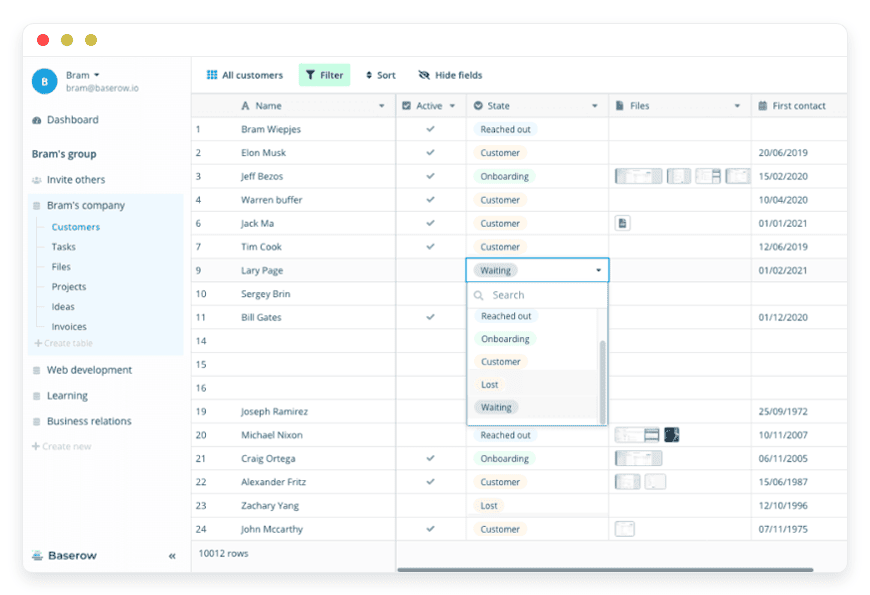
Grid View: The classic spreadsheet look. Best for bulk editing and data entry.
Gallery View: Visual cards. Perfect for creative assets, employee directories, or product catalogs where images are key.
Kanban View: A board with columns. Ideal for project management, tracking bug status (To Do, In Progress, Done), or sales pipelines.
Calendar View: Organize records by date. Essential for content schedules, event planning, and shift management.
Form View: Generate a public link to collect data. When someone fills out the form, the data lands directly in your database table.
The Application Builder
This feature changes the game. Historically, your database was stuck in the backend. With the Application Builder, you can design frontend interfaces visually.
Interface Designer: Drag-and-drop elements like headers, text, tables, and forms onto a canvas to build a website or internal tool.
Data Binding: Connect frontend elements directly to your database fields. If you update the database, the app updates instantly.
Authentication: Allow users to log in to your app. You can control visibility so that a logged-in user only sees the data relevant to them (e.g., a client only sees their own invoices).
Logic & Actions: Define what happens when a button is clicked. You can navigate to different pages, update records, or trigger notifications.
Baserow AI
Baserow integrates generative AI directly into your workflow to automate content creation.
Generative Fields: You can ask AI to write product descriptions, summarize long text, or translate content based on data in other columns.
Data Cleaning: Use AI to normalize messy data, extract email addresses from blocks of text, or categorize feedback based on sentiment.
Bulk Processing: Process thousands of rows with AI prompts in one go, turning hours of manual data entry into a task that takes minutes.
Robust API & Developer Tools
For developers, Baserow acts as a "Headless" database.
REST API: Every table gets its own endpoints. You can Create, Read, Update, and Delete (CRUD) data programmatically from any other software.
Auto-Generated Documentation: The documentation updates automatically based on your specific table names and fields. You can copy-paste curl requests or JavaScript code directly from the docs.
Webhooks: Trigger external events (like sending an email or updating a Slack channel) whenever a row is created or changed. This makes Baserow the perfect "brain" for your automation stack.
Solutions per Industry
Baserow is versatile enough to serve almost any sector. Here is a detailed look at how six distinct industries apply the software to solve real problems.
1. Manufacturing & Logistics
The Pain Point: Inventory tracking is often split across paper logs, clipboards, and disconnected legacy systems that don't talk to each other.
The Solution: Manufacturers use Baserow to build a central "Source of Truth" for inventory. They link "Raw Materials" tables to "Production Schedules." With the Kanban view, floor managers can track an item's journey from assembly to quality control to shipping. The API can ingest data from barcode scanners automatically, updating stock levels in real-time. This reduces "ghost inventory" where the system says you have parts that aren't actually on the shelf.
2. Marketing & Creative Agencies
The Pain Point: Agencies struggle with managing multiple clients, thousands of creative assets, and approval workflows. Email threads are where approvals go to die.
The Solution: Agencies create a dedicated Workspace for each client in Baserow. They use the Gallery View to present ad creatives for approval. The "Form View" is sent to clients to collect creative briefs in a structured format. By using the Calendar View, the entire agency can see the content publishing schedule across all clients in a single master view. This transparency reduces "status update" meetings by half.
3. Real Estate & Property Management
The Pain Point: Agents juggle client details, property listings, viewing schedules, and maintenance requests in different apps.
The Solution: Agencies create a unified CRM in Baserow. A "Properties" table links to a "Clients" table and a "Maintenance" table. Using the Calendar view, agents can see viewing appointments. Furthermore, they can use the Application Builder to create a public-facing listing site. When a property is marked "Sold" in the database, it automatically disappears from the website, eliminating the risk of advertising unavailable units.
4. Human Resources & Recruitment
The Pain Point: Hiring involves hundreds of resumes, interview notes, and scorecards scattered across emails and folders.
The Solution: HR teams build an Applicant Tracking System (ATS) entirely in Baserow. Candidates apply via a public Form View. Their data populates the "Candidates" table. Interviewers use a private internal form to submit scores and notes, which are linked to the candidate's record. Automated webhooks can even email the candidate when their status changes to "Interview Scheduled" or "Offer Sent."
5. Software Development & Product Management
The Pain Point: Development teams need to track bugs, feature requests, and sprint planning, but enterprise tools like Jira can be overly complex and expensive for smaller teams.
The Solution: Product teams use Baserow to manage their roadmap. They collect user feedback via forms, link that feedback to specific "Feature Ideas," and prioritize them using a Kanban board. Since Baserow has an API, developers can hook it into their CI/CD pipeline—automatically moving a ticket to "Deployed" when code is pushed to production.
6. Higher Education & Research
The Pain Point: Research data is complex, massive, and needs to be secure yet accessible to specific teams. Standard spreadsheets crash with large datasets.
The Solution: Universities use Managed Baserow Hosting to store research datasets. The granular permission settings ensure that only authorized researchers can modify data, while students might have "read-only" access. The formula fields allow for complex calculations directly within the database. Because it is open-source based, it adheres to the transparency requirements often mandated by grant funding.
Baserow vs Proprietary Alternatives
It is important to understand where Baserow sits in the market compared to proprietary SaaS tools like Airtable or Smartsheet. While the interface may look similar, the underlying philosophy—and the limitations—are vastly different.
| Feature | Baserow (Managed) | Proprietary Alternatives |
| Row Limits | Unlimited (Hardware dependent) | Strictly Capped (Expensive to upgrade) |
| API Rate Limits | High (Customizable) | Low / Restrictive |
| Code Access | Open Source | Closed Source |
| Data Control | You have access to the data | Your data lives on their cloud |
| Pricing Model | Flat Infrastructure Fee | Per User / Per Month (Scales poorly) |
With proprietary tools, you are renting access to your data. As you scale, the costs skyrocket, and the row limits become a bottleneck. You often hit a "paywall" just to add a few more records. With Managed Baserow on DANIAN, you are limited only by the server resources, which are far cheaper and more scalable. You aren't penalized for growth.
Use Cases and Applications
The flexibility of Baserow allows for endless possibilities. Here are five practical ways to use it immediately:
Headless CMS: Use Baserow to store blog posts, author details, and images. Connect your website (Next.js, Nuxt, WordPress) to the Baserow API to display the content. This allows non-technical writers to update the site without touching code.
Marketing Campaign Tracker: Organize ad assets, copy, and UTM links. Use the Gallery view to visualize creative assets and the Calendar view for scheduling launch dates.
Bug Tracking System: Developers can log issues, assign priority, and link bugs to specific feature requests. You can attach screenshots and log files directly to the row.
Event Management: Manage guest lists, catering preferences, and vendor contacts in linked tables. Use the Form view to collect RSVPs and the Grid view to check people in at the door.
Digital Asset Management (DAM): Store company logos, brand guidelines, and legal documents. Use tagging and filtering to make sure the marketing team always finds the correct version of a file.
How DANIAN Helps
We function as the quiet enabler of your technology. We believe you should spend your time architecting your data, not fixing broken dependencies or managing Linux updates.
Fully Managed: We handle the hosting lifecycle. From the initial launch to regular system updates, we ensure the environment is optimized for Baserow’s specific requirements (Python, PostgreSQL, Redis). You don't need a DevOps engineer to use Baserow.
Backup & Monitoring: Your data is critical. We configure automated daily backups that are stored securely. If you make a mistake or delete a critical table, you can restore previous versions. We also monitor uptime 24/7 to ensure your database is always available.
SSL & Firewall: Security is standard, not an upgrade. We implement custom firewalls and automatic SSL certificates to ensure your connection is always encrypted. We block malicious traffic before it reaches your data.
Seamless Updates: Baserow releases new features frequently. We apply these updates and security patches so you always have the latest tools without the risk of breaking your installation.
Guaranteed Performance: As your database grows from 1,000 rows to 100,000, our scalable infrastructure ensures your queries remain fast and your apps stay responsive. We tune the database specifically for high-performance reads and writes.
7-Day Free Trial: We are confident in our platform. You can test the full capabilities of Managed Baserow Hosting with zero risk.
How to Get Started
Getting your own Baserow running takes less time than reading this article. We have removed the friction of installation entirely.
Sign Up: Create your account at danian.co.
Select Baserow: Find Baserow in our application catalog.
Launch: Click start. We handle the provisioning, networking, and database setup.
Login: Within minutes, you will have a URL to your private Baserow dashboard.
FAQ
1. Is Managed Baserow compatible with Airtable import?
Yes. Baserow has a robust import tool designed specifically to migrate data from Airtable. It brings over your tables, fields, and even your views, making the switch incredibly easy.
2. Do I need to know SQL to use Baserow?
No. The interface is designed to be as intuitive as a spreadsheet. You use a graphical interface to create tables and link records. However, if you are a developer, you can interact with the data programmatically via the API.
3. How does pricing work compared to SaaS?
SaaS tools often charge "per user." If you have 10 employees, you pay 10x. Managed hosting charges for the server resources. This means you can often have unlimited users on your instance without your costs doubling or tripling.
4. What happens if I outgrow the server?
Scaling is handled by DANIAN. If you need more CPU, RAM, or storage because your database has grown, we can upgrade your resources with minimal downtime.
Conclusion
Baserow represents the future of data management: open, flexible, and visual. It removes the barrier between having a database and being able to use it. Whether you are building a simple inventory list or a complex internal application for a large organization, Baserow scales with you.
It offers the best of both worlds: the ease of use of a consumer app with the power and stability of an enterprise database. Don't let the complexity of server administration stop you from using the best no-code tool on the market. Let us handle the infrastructure while you build the future of your business.


